

Your lower back aches. Maybe it crept in after a long day at your desk. Maybe you bent over to pick something up and felt that familiar twinge. Either way, you want relief — and you want it now.
We get it. Lower back pain is the single most common reason patients walk into our Ottawa clinic. And the first thing we tell most of them? Start moving.
The 10 exercises below are the same ones we prescribe to our patients every day. They target the muscles behind most lower back pain: tight hip flexors, weak glutes, and a core that’s forgotten how to work.
One important note before you scroll ahead. Not every exercise works for every type of back pain. If your pain runs down your leg, or you notice numbness and tingling, skip the exercises and book a quick assessment with us first. What we’re covering here works best for mechanical low back pain — that dull, stiff ache from too much sitting and not enough moving.
Here’s something that surprises most patients. Their back pain usually isn’t caused by their back.
It’s caused by a muscle imbalance that physiotherapists call lower-cross syndrome. When you sit for hours every day, your hip flexors shorten and tighten. Your glutes switch off. Your core weakens. And your lower back picks up the slack for all three.
A 2024 clinical trial published in Folia Medica confirmed that exercises targeting this exact pattern — stretching hip flexors while strengthening glutes and core — significantly reduced pain and disability in patients aged 20 to 40.
“About 80% of my patients’ problems come from sedentary jobs with insufficient physical activity,” says Dr. Courtney Broadhurst, chiropractor at Kent Chiro-Med. “Weak core and glutes leading to mechanical low back pain — that’s what I see most.”
So the exercises below don’t just stretch random muscles. They fix the specific pattern that’s causing your pain.
Three things to know.
Pain is your guide.
A gentle stretch is fine. Sharp or shooting pain is not. Stop any exercise that makes things worse.
Consistency matters more than intensity.
Ten minutes a day beats a 45-minute session once a week. Your muscles need repetition to change.
These exercises are a starting point.
If your pain hasn't improved after two weeks of daily work, something else is going on — and that's when a professional assessment saves you months of guessing.

We’ve organized these from simplest to most challenging. Start with the first three. Add more as your pain decreases and your confidence grows.
| # | Exercise | Primary Target | Dose | Time |
|---|---|---|---|---|
| 1 | Knee-to-Chest | Tight lower back | 3 each side | 2 min |
| 2 | Pelvic Tilt | Core activation | 10 reps | 1 min |
| 3 | Glute Bridge | Weak glutes | 3×10 | 3 min |
| 4 | Bird-Dog | Core stability | 3×8 each | 3 min |
| 5 | Cat-Cow | Spinal mobility | 10 reps | 2 min |
| 6 | Hip Flexor Stretch | Tight hip flexors | 2 each side | 2 min |
| 7 | Dead Bug | Deep core | 3×8 each | 3 min |
| 8 | Child’s Pose | Tension release | 60 sec | 1 min |
| 9 | Hamstring Stretch | Tight hamstrings | 3 each leg | 2 min |
| 10 | Foam Roller Extension | Mid-back stiffness | 10 reps | 2 min |
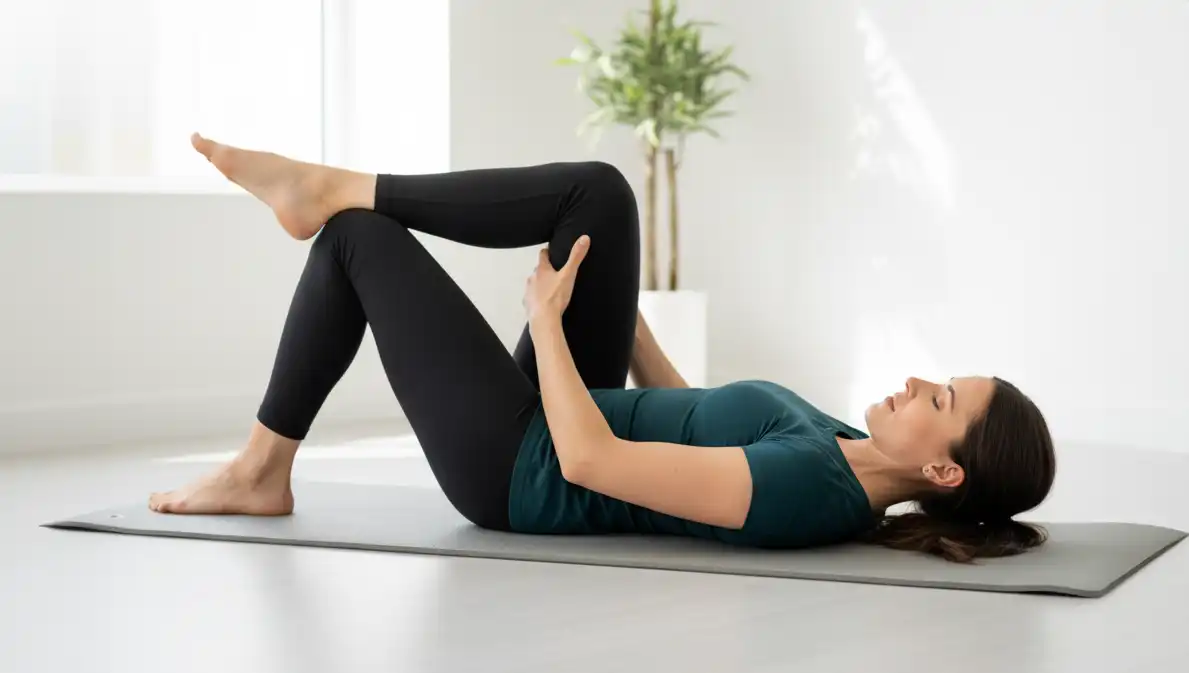
This is the gentlest exercise on the list. It’s where we start almost every patient.
How to do it:
Dose: 3 reps each side, twice daily.
💡 Tip: Keep your opposite foot flat on the floor the whole time. Breathe slowly into your belly — holding your breath tenses your muscles and defeats the purpose.

Most people with lower back pain have a core that’s gone to sleep. This exercise wakes it up.
How to do it:
Dose: 10 reps, 3 times per day.
💡 Tip: This is a tiny movement. If your shoulders lift off the floor, you’re working too hard. Place a hand under the small of your back and try to flatten your spine against it — that’s the right effort.

If we could only prescribe one exercise for lower back pain, this would be it. Weak glutes force your lower back to compensate for every step, every stair, every bend. Bridges fix that.
How to do it:
Dose: 3 sets of 10, once daily.
💡 Tip: Drive through your heels, not your toes. If you feel the burn in your hamstrings instead of your glutes, press harder through your heels and really focus on the squeeze at the top.

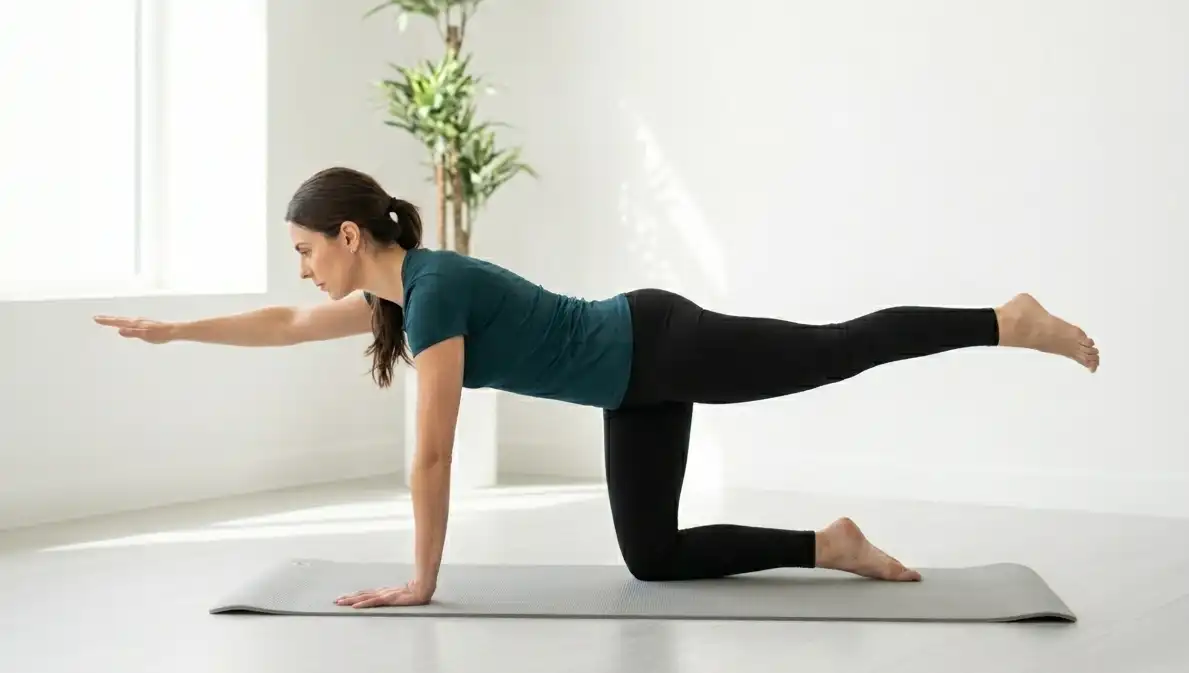
This one teaches your core and glutes to work together — exactly the coordination that desk work destroys.
How to do it:
Dose: 3 sets of 8 each side, once daily.
💡 Tip: The goal is zero rocking through your hips. If you can’t keep your pelvis level, start with just the leg extension until you build enough stability for the full movement.
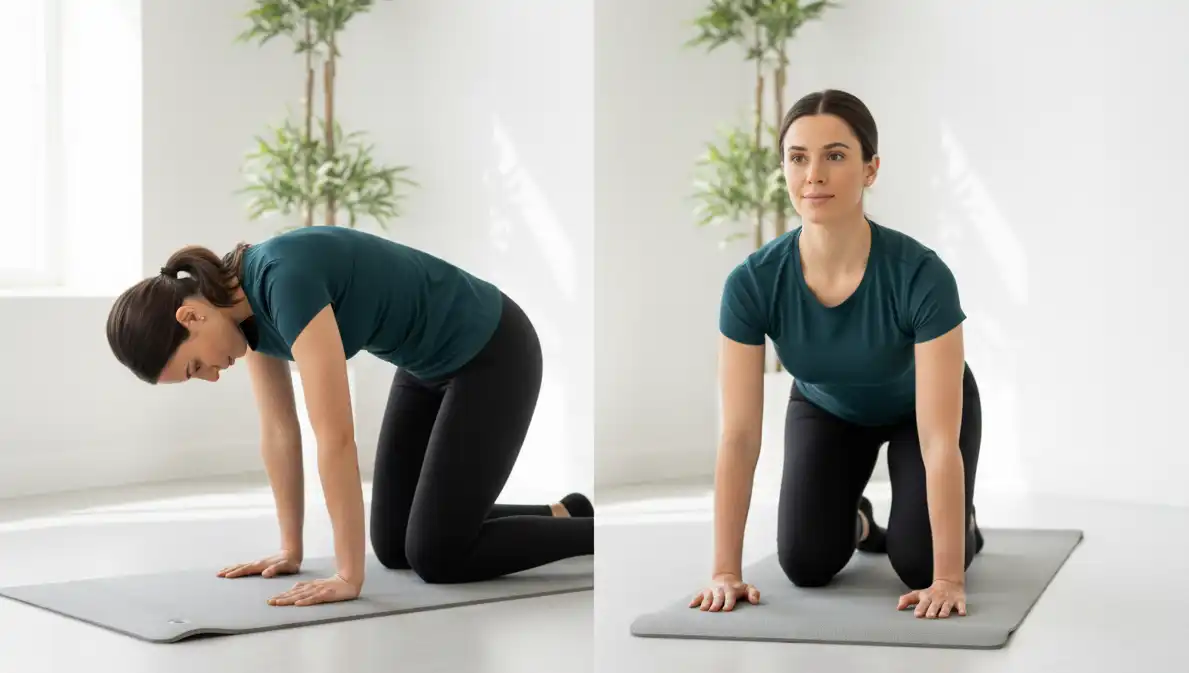
Your spine was designed to move. When it’s been locked in a seated position for 8 hours, cat-cow gives it permission to bend and extend again.
How to do it:
Dose: 10 slow reps, 2 to 3 times per day.
💡 Tip: This is the perfect first-thing-in-the-morning exercise. It takes 90 seconds and loosens every segment of your spine before you even stand up.
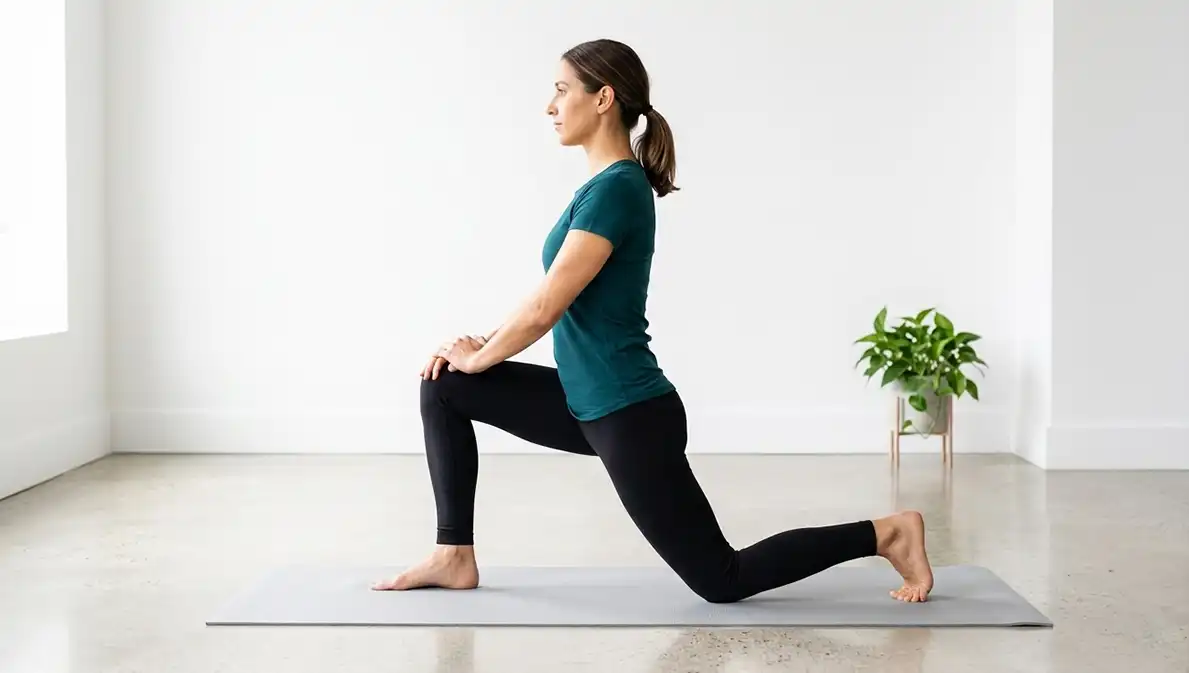
Tight hip flexors are the silent driver behind most desk-worker back pain. They pull your pelvis forward and force your lower back into a compressed arch. This stretch reverses that.
How to do it:
Dose: 2 reps each side, twice daily.
💡 Tip: Stay upright — don’t lean forward. To go deeper, squeeze the glute on the kneeling side. This releases the hip flexor through a technique called reciprocal inhibition.

This exercise looks easy. It isn’t. The dead bug trains the deep stabilizing muscles that act like a natural brace around your spine.
How to do it:
Dose: 3 sets of 8 each side, once daily.
💡 Tip: Your lower back must stay flat to the floor the entire time. The moment it arches up, you’ve gone too far. Shorten your range of motion and build from there.

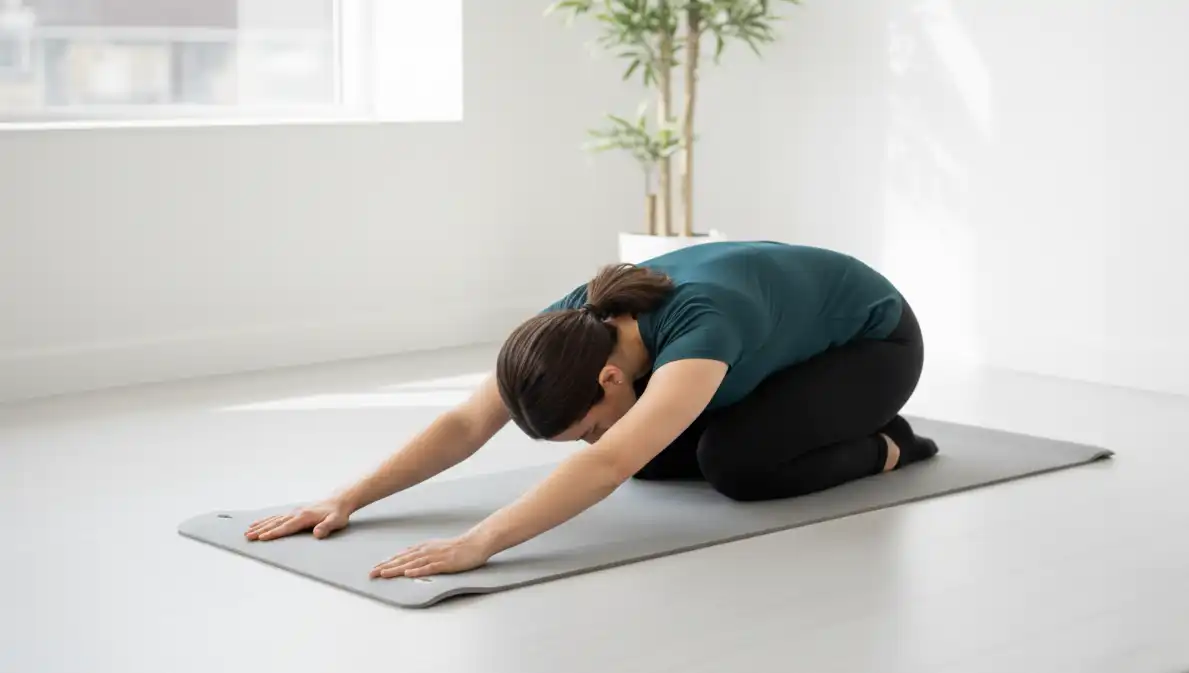
Think of this as your reset button. Child’s pose decompresses your lower back and calms your nervous system. We use it both as a standalone stretch and as rest between harder exercises.
How to do it:
Dose: Hold 30 to 60 seconds. Repeat 3 times.
💡 Tip: For a deeper stretch on one side, walk both hands to the left to target the right side of your lower back, then switch.

Tight hamstrings tug your pelvis out of alignment and stiffen your lower back. This stretch breaks that cycle.
How to do it:
Dose: 3 reps each leg, once or twice daily.
💡 Tip: Can’t reach your leg? Loop a towel around your foot. Keep your opposite leg and lower back flat on the floor throughout.

Here’s something most people miss. When your mid-back is stiff, your lower back has to move more to compensate. Freeing up the thoracic spine lets your lower back relax.
How to do it:
Dose: 10 reps, once daily.
💡 Tip: Important: do NOT roll the foam roller over your lower back. Your lumbar spine doesn’t have the rib cage for protection. Keep the roller between your shoulder blades and the bottom of your ribs.
Reading instructions is helpful. Seeing them done correctly is better.
In this short video, Dr. Courtney Broadhurst from our clinic walks you through three of the exercises above — cat-cow, cobra, and bird-dog. Pay attention to how slowly she moves. That controlled pace is what makes the difference.
Ten exercises is a lot. You don’t need to do all of them every day.
Use the interactive tool below to get a personalized routine based on your type of pain. Pick your main issue — stiff, weak, or both — and we’ll select the five best exercises for you.
Build Your 10-Minute Routine
Select your main issue. We'll pick the best exercises for you.
What describes your back pain best?Prefer a simple default? Here’s the routine we recommend for most desk workers:
Do this every morning. Add the remaining five on alternate days. Consistency is what changes things — not variety.
These exercises are safe for most people with mechanical low back pain. But some symptoms signal something more serious. Stop and get assessed if you notice:
Any of these suggest more than muscle tightness. A back pain physiotherapy assessment identifies the real cause and gets you on the right path — before weeks of guessing turn into months.
“When I see a patient who’s been doing exercises for weeks with no improvement, it almost always means the exercises were targeting the wrong muscles. A proper assessment takes the guesswork out.”
— Dr. Courtney Broadhurst, Kent Chiro-Med
When your lower back pain keeps coming back — or never fully goes away — home exercises alone won’t reach the root cause. At Kent Chiro-Med in downtown Ottawa, we figure out why your back hurts and build a treatment plan around it: hands-on therapy, targeted strengthening, and advanced technology like TECAR.
Here’s what makes our clinic different:
Book your 60-minute assessment. Private rooms. Direct insurance billing. Evening + Saturday appointments.
