
Headache Treatment in Ottawa
- Headaches with neck stiffness or shoulder tension
- Desk, phone, and posture-related headache patterns
- Chiropractic, physiotherapy, acupuncture, soft tissue work, and exercise guidance when appropriate


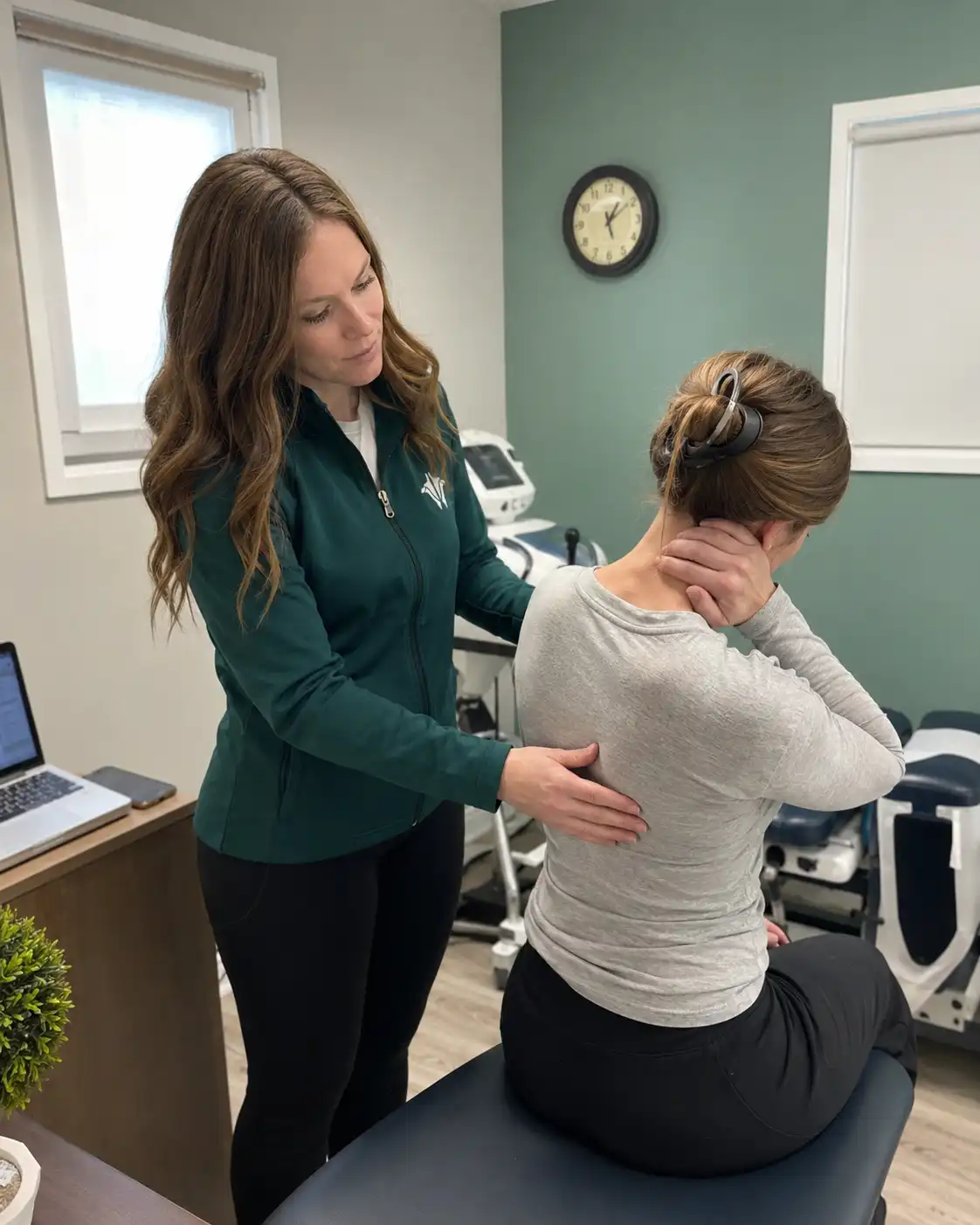
Headaches, Neck Stiffness, and Posture
Many patients do not connect their headaches with their neck or posture at first.
They may feel pressure around the base of the skull, tightness behind the eyes, tension through the shoulders, or headaches that appear after long periods of sitting, working on a laptop, looking down at a phone, or sleeping in an awkward position.
Some headaches may be related to migraine, stress, jaw tension, neck irritation, previous injury, or other medical factors. Others may be connected to tension through the neck, upper back, shoulders, or jaw.
The goal of your assessment is not to guess. It is to understand your pattern clearly, explain what may be contributing to your symptoms, and recommend the safest next steps.
What Happens During a Headache Assessment?
During your first visit, your practitioner will review your health history, ask about your symptoms, and assess how your neck, shoulders, upper back, and posture may be contributing to your headaches.
They may ask questions such as:
- When do your headaches usually start?
- Do they happen after desk work, phone use, driving, studying, or screen time?
- Do you also feel neck stiffness, jaw tension, shoulder tightness, or pain at the base of the skull?
- Do certain sleeping positions, workouts, or work tasks make symptoms worse?
- Have your headaches changed recently or become more frequent?
From there, your practitioner will explain what they find and recommend a care plan based on your symptoms, goals, and comfort level.
Care may include chiropractic treatment, physiotherapy, acupuncture, soft tissue therapy, rehab exercises, posture guidance, or a combination of approaches depending on the assessment.
Related services:
Compare common headache patterns
Use the filters to compare common clues and triggers. This guide does not diagnose the cause of a headache.
| Pattern | Common clues | Common triggers | What may help clarify it |
|---|---|---|---|
| Desk & screen-related | Neck stiffness, shoulder tension, pressure behind the eyes | Laptop work, low monitor, long meetings, prolonged sitting | Reviewing desk setup, movement breaks, neck and upper-back movement |
| Phone posture / tech neck | Forward head posture, upper-back tension, pressure at the base of the skull | Phone use, tablets, gaming, studying, looking down for long periods | Screen height, movement habits, neck strength, shoulder support |
| Neck-related | Pain beginning near the base of the skull, limited neck movement, tenderness | Awkward sleep, driving, long sitting, previous neck irritation | Assessing neck movement, shoulders, upper back, and posture habits |
| Jaw & shoulder tension | Jaw tightness, elevated shoulders, temple pressure, upper-back tension | Stress, clenching, prolonged posture, repetitive work | Looking at jaw, neck, shoulder, and upper-back tension together |
| Recent injury | A new or different headache after a fall, collision, sports injury, or concussion | Head impact, whiplash, car accident, recent trauma | A careful assessment; unusual or severe symptoms may need urgent care |
Common Headache Patterns We Assess
Headaches can show up in different ways. Some patients feel pressure around the forehead or behind the eyes. Others feel pain that starts near the base of the skull and travels upward. Some notice headaches after long hours at a desk, phone use, driving, studying, or sleeping in an awkward position.
At Kent Chiro-Med, we commonly assess headache patterns that may be connected to:
- Neck stiffness
- Forward head posture
- Desk posture
- Phone or laptop use
- Shoulder and upper back tension
- Jaw tension
- Previous injury, car accident, sports injury, or concussion
- Stress, sleep position, or daily movement habits
The right care plan depends on what your practitioner finds during your assessment.
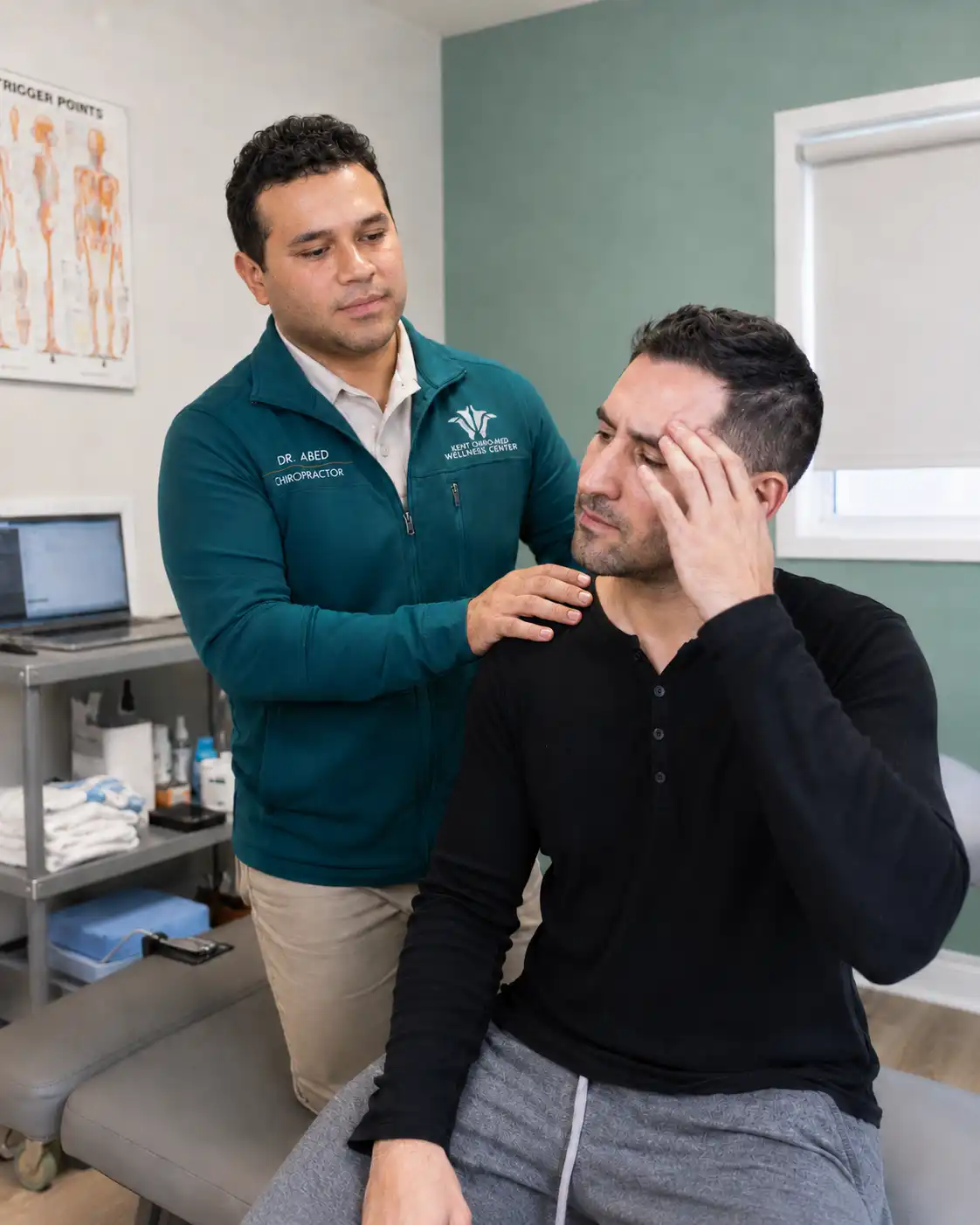
Tech Neck and Tension Headaches

“Tech neck” is a common way to describe neck strain that can happen when you spend long periods looking down at a phone, laptop, tablet, or workstation.
Over time, this posture may contribute to stiffness through the neck and upper back. For some patients, that tension can be associated with headaches, especially around the base of the skull, temples, forehead, or behind the eyes.
Common patterns include:
- Headaches after long periods of laptop or phone use
- Tightness through the neck and shoulders
- Pressure at the base of the skull
- Headaches that build during the workday or school day
- A feeling that the head sits forward from the shoulders
- Neck stiffness when turning or looking up
The solution is not always as simple as “sit up straight.” Many patients need a combination of movement breaks, posture changes, hands-on care, mobility work, and strengthening exercises to reduce the strain that keeps building up.
Desk Posture and Headache Patterns
Desk workers often deal with headaches that build slowly through the day.
This can happen when the monitor is too low, the chair does not support the body well, the shoulders stay rounded forward, or the neck stays in one position for hours. Long sitting can also affect the upper back, ribs, shoulders, jaw, and breathing patterns.
Desk-related headaches may feel worse:
- Near the end of the workday
- After long meetings or computer sessions
- After working from a laptop without a proper monitor
- When the shoulders feel tight or elevated
- When the neck feels stiff after sitting
At Kent Chiro-Med, your practitioner may assess your neck movement, shoulder position, upper back mobility, and work habits. Your care plan may include treatment in the clinic plus simple changes you can use at your desk.
Helpful starting points may include:
- Raising your monitor closer to eye level
- Keeping your elbows supported
- Taking short movement breaks during the day
- Avoiding long periods with your chin poking forward
- Using exercises that build better neck and upper back support
Phone Posture in Younger Patients
Younger patients and students often spend long periods on phones, tablets, laptops, or gaming setups.
Looking down for long periods may contribute to neck strain, forward head posture, shoulder tension, and tension-type headache patterns. This does not mean phone use is the only cause of the headache. It means it may be one habit worth assessing if headaches keep returning.
Parents may notice that their child or teen complains of:
- Headaches after school or studying
- Neck stiffness after phone use
- Shoulder tension after gaming or laptop work
- Poor posture during screen time
- Headaches that improve after resting or changing positions
A proper assessment can help identify whether the neck, shoulders, jaw, posture habits, or other factors may be contributing. From there, the care plan may include treatment, education, home exercises, and practical screen-use adjustments.


Neck-Related Headaches
Some headaches may be connected to irritation or stiffness in the neck. These are sometimes described as neck-related or cervicogenic headache patterns.
Patients may notice:
- Pain or pressure that starts near the base of the skull
- Neck stiffness before or during the headache
- Headaches that are worse after sleeping awkwardly
- Symptoms that increase after long sitting or driving
- Limited neck movement
- Tenderness through the upper neck, shoulders, or jaw
A neck-related headache pattern should be assessed properly, especially if it keeps returning, limits your movement, affects work or sleep, or feels different from your usual symptoms.
Treatment may include a combination of neck mobility work, soft tissue therapy, chiropractic care, physiotherapy exercises, acupuncture, and posture guidance depending on what your practitioner finds.
Care Options for Neck and Posture-Related Headaches
Your care plan depends on your assessment. Kent Chiro-Med offers multiple treatment options under one roof, which allows your practitioner to recommend the approach that best matches your symptoms and comfort level.
Chiropractic Care
Chiropractic care may help support better joint mobility, reduce neck stiffness, and address movement patterns that may be contributing to headache symptoms. Adjustments are only one option. If an adjustment is not appropriate or you are not comfortable with it, your practitioner can recommend other approaches.
Physiotherapy
Physiotherapy may help improve neck strength, shoulder control, upper back mobility, and posture habits. This is especially useful when headaches are connected to desk work, long sitting, screen use, sports, or recurring muscle tension.
Acupuncture
Acupuncture may be included when muscle tension, neck stiffness, or nerve-related discomfort may be contributing to symptoms. Your practitioner will explain whether acupuncture is appropriate for your situation.
Soft Tissue Therapy
Soft tissue work may be used to address tension through the neck, shoulders, upper back, jaw, or the muscles near the base of the skull.
Exercise and Posture Guidance
Home exercises may be used to support better movement between visits. Your practitioner may also suggest changes to your desk setup, phone habits, pillow position, or workout routine when those patterns are contributing to recurring symptoms.
We most often work with students, office workers and other sedentary professionals whose headaches stem from prolonged sitting and poor posture. We also treat athletes, labourers and individuals recovering from motor‑vehicle accidents or concussions. Early assessment and targeted home exercises (stretching, strengthening and postural retraining) improve recovery and help prevent chronic headaches.
Who We Help
When Headaches May Be Connected to the Neck — Dr. Maryam explains
When Should Headaches Be Assessed?
You should consider booking an assessment when headaches are recurring, affecting your daily routine, or appearing together with neck stiffness, shoulder tension, jaw tension, or posture-related discomfort.
A proper assessment may be helpful if:
- Your headaches happen after desk work, studying, driving, or phone use
- You also feel neck stiffness or pain at the base of the skull
- Your headaches are becoming more frequent
- Your headaches affect your work, school, sleep, or exercise
- You rely on short-term relief but the same pattern keeps returning
- You recently had a fall, car accident, sports injury, or concussion
- You are unsure whether your headaches are related to your neck, posture, jaw, or another factor
If your headache is sudden and severe, follows a head injury, or is associated with confusion, fainting, fever, weakness, numbness, vision changes, speech changes, or other unusual symptoms, seek urgent medical care rather than waiting for a clinic appointment.

Assessment-Based Care That Matches Your Symptoms
At Kent Chiro-Med, care starts with an assessment. Your practitioner will look at your symptoms, movement, comfort level, daily habits, and goals before recommending treatment.
The goal is to help you understand what may be contributing to your headaches and what steps may support better movement, less strain, and a safer return to work, school, exercise, or daily activity.

At Kent Chiro-Med headache clinic, we combine traditional techniques with cutting-edge treatments:
Advanced Diagnostics
Our Ottawa headache clinic utilizes the latest technology for accurate assessments.
Manual Therapy
Research shows that targeted manual therapy can significantly reduce pain and improve function in patients with cervicogenic headaches [7].
Exercise Prescription
Customized exercise programs to strengthen neck and back muscles, improving overall headache management [8].
Stress Management Techniques
We provide tools to help you manage stress, a common trigger for many types of headaches [9].
TECAR Therapy
TECAR therapy may be considered when muscle tension, stiffness, or tissue irritation is part of the pattern your practitioner finds during the assessment. It is not the right option for every patient. Your practitioner will explain whether it makes sense for your symptoms and goals.
Say Goodbye to
Pain and Hello to Relief
Our experienced chiropractors offer non-invasive relief with personalized plans, flexible scheduling, and a welcoming clinic.
Don't let fear stop you - schedule your appointment for a better life.
Meet Our Expert Team
Our team of experienced practitioners is dedicated to providing you with the highest quality care:

Dr. Maryam Hassanzadeh
Chiropractor
a.ka Mama Bear
Over 15 years of experience in chiropractic care
Specialized training in scoliosis-specific chiropractic techniques
Clinical Director at Kent Chiro-Med Wellness Clinic

Dr. Courtney Broadhurst
Chiropractor
a.k.a Sporty Spice
Certified chiropractor with extensive experience in treating musculoskeletal conditions
Graduate of the Canadian Memorial Chiropractic College, magna cum laude
Additional qualifications in emergency first response, athletic taping, instrument assisted soft tissue mobilization and Contemporary Medical Acupuncture

Dr. Abed Hamidi
Chiropractor
a.k.a Movement Maverick
Passionate about helping individuals return to their daily routines and re-engage in activities they love
Extensive knowledge and experience from his own journey as an athlete
Committed to supporting patients in achieving their personal health goals

Ghaith Dhaidan
Physiotherapist
a.k.a Army Boot Camp
- Graduate from the Masters of Science in Physical Therapy program at the University of Toronto.
- Holistic Approach: Provides a holistic approach to enhancing quality of life.
Real Results from Real Patients
Nadia's Journey

I have been seeing Dr Maryam for almost a year. I had severe pain in my neck, and headaches when I first started my treatment. After several treatments my neck felt much better and my headaches disappeared. Dr Maryam helped me with my posture as well, prescribed exercises. She encouraged me to improve my posture and provided a plan of exercises. I feel much much better now. Her treatment emphasized on exercising and no medication and that was what I was looking for! Dr. Maryam is very kind and compassionate and makes you feel as ease. She is also very passionate about her patients and tries every way to improve their condition. I am so very grateful to Dr Maryam for making me feel much much better. Thank you Dr Maryam and God bless you!🙏
Mehdi Heyrani

I booked my first appointment with Dr. Courtney Broadhurst on late March 2022, as I had back pain due to my desk arrangement setup. Since then, after few sessions, I can say that I am quite relieved of my back pain and the scattered disturbing headaches (due to the neck muscle spasm). The level of patience and energy that she spends on each session is admirable as no matter when the session time’s up, she will be done when the treatment is completed. The follow up conversations between the sessions containing the recommended exercise tutorials and the reminder to do them, are well appreciated due to my busy daily schedule. Nevertheless, the friendly environment and kind staff are adding to the positive vibe of the clinic.


Trusted by people like you
Benefits of an Assessment-Based Approach
A headache assessment can help you better understand your symptoms and what may be contributing to them.
Depending on your condition, care may help support:
- Better neck and upper back mobility
- Reduced tension through the neck, shoulders, or jaw
- Better awareness of desk, phone, and posture habits
- A safer return to work, exercise, school, or daily activity
- A clearer plan for what to do between appointments
- Long-term movement habits that may reduce recurring flare-ups
Some patients feel improvement quickly, while others need more time depending on the condition, severity, habits, and consistency with treatment.
The Kent Chiro-Med Difference
What makes our approach different for neck and posture-related headaches:
Assessment-First Care
We start by looking at your symptoms, neck movement, posture habits, work setup, and daily triggers before recommending treatment.
Chiropractic and Physiotherapy Together
Your care may include chiropractic care, physiotherapy, or both, depending on what your assessment shows and what you are comfortable with.
Posture and Daily Habit Guidance
We look at patterns that may be contributing to your headaches, including desk posture, phone posture, forward head position, sleep position, and shoulder tension.
Multiple Treatment Options
Care may include soft tissue therapy, acupuncture, mobility work, strengthening exercises, posture coaching, or hands-on treatment based on your needs.
Clear Home Support
Your practitioner may recommend simple exercises, desk adjustments, movement breaks, or self-care steps to help support your progress between visits.
Before You Book
Common Questions Patients Ask
Real questions we hear at the clinic — answered clearly, so you know what to expect.
Can neck stiffness contribute to headaches?
Yes, neck stiffness may be one factor that contributes to certain headache patterns. Some patients notice pressure at the base of the skull, tightness through the shoulders, or headaches that appear when their neck feels restricted.
A proper assessment can help determine whether your neck movement, posture, jaw tension, or other factors may be involved.
Can desk posture cause headaches?
Desk posture can contribute to headache patterns for some patients, especially when the neck and shoulders stay in the same position for long periods.
Common triggers may include a low monitor, laptop use without a separate screen, unsupported arms, rounded shoulders, or long periods without movement breaks.
Can phone posture cause tension headaches?
Phone posture may contribute to neck strain, forward head posture, shoulder tension, and tension-type headache patterns, especially in students, teens, and people who spend long periods looking down.
The goal is not to blame the phone. The goal is to assess the pattern and help you build better habits, movement, and support.
What is tech neck?
Tech neck is a common term for neck strain linked to phone, laptop, tablet, or screen use. It often involves looking down or holding the head forward for long periods.
For some patients, this may be associated with neck stiffness, upper back tension, shoulder tightness, and headaches.
How long will it take to feel better?
Recovery depends on the cause of the headache pattern, how severe it is, how long it has been present, and how consistently you follow your care plan.
Some patients feel improvement quickly, while others need more time depending on the condition, habits, and treatment consistency.
Why do headaches come back?
Headaches may come back when the same posture habits, neck stiffness, shoulder tension, jaw tension, sleep position, or work setup keeps irritating the same area.
That is why your care plan may include treatment, education, exercises, posture guidance, and simple changes to your daily routine.
What treatments may be included?
Care may include chiropractic treatment, physiotherapy, acupuncture, soft tissue therapy, rehab exercises, posture coaching, ergonomic advice, or a combination of approaches depending on your assessment.
Your practitioner will explain what they recommend and why.
Can I keep going to the gym during treatment?
In many cases, you do not need to stop going to the gym completely. The better approach is often to adjust the right exercises, lower the intensity for a while, avoid movements that make symptoms worse, and rebuild gradually.
Your practitioner can help you understand which movements are safe, which ones to avoid for now, and when it may be time to progress. If you train hard, our sports physiotherapy team can guide a safer return to activity.
What happens during the first visit?
Your practitioner will review your health history, ask about your symptoms, assess your movement, and explain what may be contributing to your headaches.
From there, they will recommend a treatment plan based on your condition, goals, and comfort level. When appropriate, treatment may begin during the first visit.
What if I'm nervous about a chiropractic adjustment?
That is completely normal. Care starts with an assessment and a conversation about your symptoms, comfort level, and treatment options.
An adjustment is only one tool. If it is not appropriate or you are not comfortable with it, your practitioner may recommend other options such as mobilization, soft tissue therapy, acupuncture, exercises, TECAR therapy, spinal decompression, or physiotherapy-based care.
What types of headache patterns do you assess?
At Kent Chiro-Med, we commonly assess headache patterns that may be connected to neck stiffness, shoulder tension, desk posture, phone posture, jaw tension, or upper back tightness.
This may include tension-type headaches, neck-related headaches, cervicogenic headache patterns, and headaches that appear after long periods of sitting, studying, driving, or screen use.
Some headaches may involve migraine, concussion, injury, or other medical factors. Your practitioner will review your symptoms and recommend the safest next step based on your assessment.
Do I need a referral from my doctor to visit your headache clinic?
No, you don’t need a referral to visit our clinic. We welcome both direct bookings and referrals. However, if you have insurance coverage, you may want to check if your policy requires a referral for chiropractic or physiotherapy services.
Still have a question?
The clearest next step is a proper assessment.
Get Clarity on Your Headaches
Headaches can have different causes, but you do not have to figure it out alone.
If your headaches keep returning with neck stiffness, desk posture strain, phone posture, or shoulder tension, book an assessment so we can help you understand what may be contributing and what options may support your recovery.